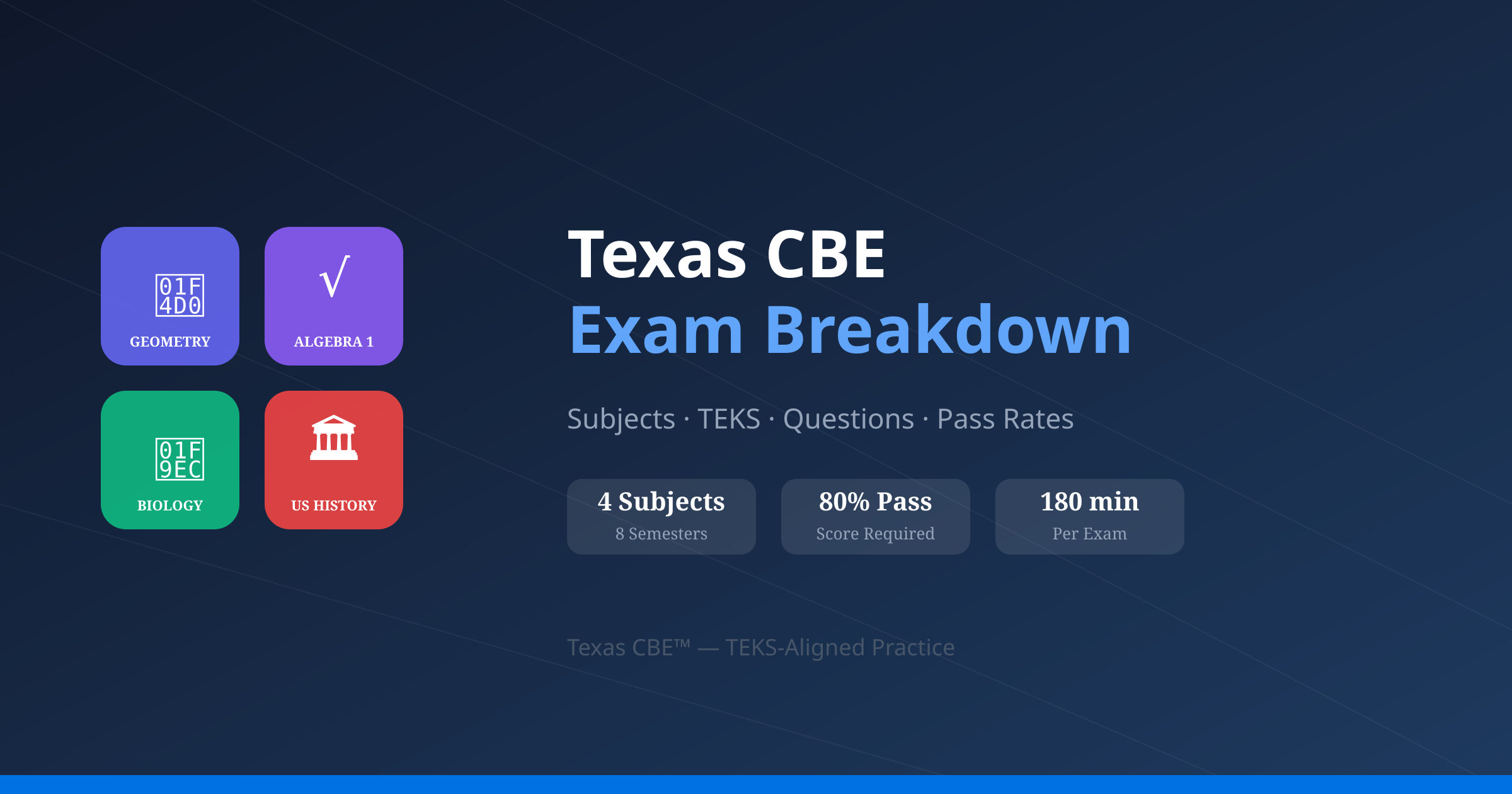
Texas CBE Exam Breakdown: Subjects, TEKS, Questions & Pass Rates


What Exactly Is on the Texas CBE Exam?
If you're preparing for a Texas Credit by Examination (CBE) (CBE) through UTHS, knowing exactly what's on the test is half the battle. This guide breaks down each subject — question by question, TEKS by TEKS — so you know exactly what to study.
All CBE exams are administered through the University of Texas at Austin High School (UTHS) and align with the Texas Essential Knowledge and Skills (TEKS) curriculum standards.
When is your district’s deadline? Every district sets its own, and most close weeks before the test. The Texas CBE district portal counts down to the next one in each district, and the 2026–2027 schedule by district lists the full year.
📐 Geometry
Exam Structure
| Semester A | 57 questions · 180 minutes |
| Semester B | 40 questions · 180 minutes |
| Passing Score | 80% |
| Calculator | Required for most questions |
TEKS Topics Covered
- Semester A: Coordinate & Transformational Geometry (TEKS 1-3), Logical Reasoning (TEKS 4), Lines & Angles (TEKS 5-6), Triangles & Similarity (TEKS 7-8), Right Triangles & Trigonometry (TEKS 9)
- Semester B: Quadrilaterals & Polygons (TEKS 5-6), Circles (TEKS 12), Area & Perimeter (TEKS 10-11), 3D Figures & Volume (TEKS 10-11), Probability (TEKS 13)
What to Expect
Geometry CBE is heavily visual — expect diagrams, coordinate planes, and figures in most questions. You'll need to know formulas for area, volume, surface area, and trigonometric ratios. About 80% of questions require calculations.
√ Algebra 1
Exam Structure
| Semester A | 52 questions · 180 minutes |
| Semester B | 50 questions · 180 minutes |
| Passing Score | 80% |
| Calculator | Required for most questions |
TEKS Topics Covered
- Semester A: Number Systems & Operations (TEKS 1A-1G), Linear Equations (TEKS 2A-4C), Inequalities (TEKS 5A-5C), Relations & Functions (TEKS 6-7), Linear Functions & Slope (TEKS 3A-3F)
- Semester B: Systems of Equations (TEKS 3), Exponents & Polynomials (TEKS 10-11), Quadratic Functions (TEKS 6-8), Data Analysis & Statistics (TEKS 4, 12), Exponential Functions (TEKS 9)
What to Expect
Algebra 1 CBE focuses on solving equations, graphing functions, and interpreting data. Word problems make up about 50% of the exam. You'll need strong skills in linear equations, slope calculations, and systems of equations.
🧬 Biology
Exam Structure
| Semester A | 50 questions · 180 minutes |
| Semester B | 50 questions · 180 minutes |
| Passing Score | 80% |
| Calculator | Not typically needed |
TEKS Topics Covered
- Semester A: Nature of Biological Sciences (TEKS 1A-4B), Cellular Biology (TEKS 5A-11B), Biochemistry & Molecular Genetics (TEKS 7A-8A), Organism Structure & Function / Body Systems (TEKS 12A-12B)
- Semester B: Genetics & Bioengineering (TEKS 1B-8B), Evolution & Natural Selection (TEKS 9A-10D), Biological Systems (TEKS 12A-12B), Ecology (TEKS 13A-13D)
What to Expect
Biology CBE is concept-heavy — there are no calculations, but you need to understand processes like photosynthesis, cellular respiration, DNA replication, and evolution. Diagrams of cells, pedigree charts, and food webs are common.
Credit by Examination asks for 80% with no prior instruction. Full-length mock exams written to the same TEKS the exam is drawn from — Algebra 1, Geometry, Biology, Chemistry and more.
See the subjects →
Every subject has free practice questions with the full worked solution. Take some and see whether they look like the exam your district set.
See the subjects →
Every Credit by Examination window we have verified from a district's own calendar — 22 districts, 75 windows, each with the source it came from.
See the deadlines →
Not a guess at what might be on it. Full worked solutions and timed mock exams built to the same TEKS the Credit by Examination is written against.
Browse the subjects →🏛️ U.S. History
Exam Structure
| Semester A | 100 questions · 180 minutes |
| Semester B | 100 questions · 180 minutes |
| Passing Score | 80% |
| Calculator | Not needed |
TEKS Topics Covered
- Semester A (Colonization to Civil War): Exploration & Colonization (TEKS 1A-6B), Geography & Regions (TEKS 12A-14C), Economics & Trade (TEKS 15A-16E), Government & Constitution (TEKS 17A-19E), Citizenship (TEKS 20A-22E)
- Semester B (Reconstruction to Modern Era): Reconstruction & Industrialization, World Wars, Cold War, Civil Rights Movement, Modern America, Science & Technology (TEKS 26A-28B), Social Study Skills (TEKS 29A-32B)
What to Expect
U.S. History CBE has the most questions (100 per semester) and covers a massive timeline. Expect questions about key events, historical figures, constitutional principles, and cause-and-effect relationships. Primary source analysis skills are important.
📊 Quick Comparison: All Subjects
| Subject | Questions | Time | Pass | Difficulty |
|---|---|---|---|---|
| Geometry A | 57 | 3 hrs | 80% | ⭐⭐⭐ |
| Geometry B | 40 | 3 hrs | 80% | ⭐⭐⭐ |
| Algebra 1 A | 52 | 3 hrs | 80% | ⭐⭐ |
| Algebra 1 B | 50 | 3 hrs | 80% | ⭐⭐ |
| Biology A | 50 | 3 hrs | 80% | ⭐⭐ |
| Biology B | 50 | 3 hrs | 80% | ⭐⭐ |
| U.S. History A | 100 | 3 hrs | 80% | ⭐⭐⭐ |
| U.S. History B | 100 | 3 hrs | 80% | ⭐⭐⭐ |
🎯 How to Pass: Top 5 Tips
- Start with Free Practice — Every subject has free sample questions. Take them first to identify your weak areas.
- Focus on TEKS, Not Textbooks — The exam tests specific TEKS standards. Study the standards, not random topics.
- Use Mock Exams — Our mock exams simulate the real test: same question count, same time limit, same 80% passing score.
- Review Explanations — After each practice question, read the explanation carefully. Understanding why an answer is correct is more valuable than memorizing it.
- Manage Your Time — With 3 hours per exam, you have roughly 2-3 minutes per question. Don't spend more than 5 minutes on any single question.
Worried about hitting 70% (UTHS) or 80% (district)? Pulling a free sample is the fastest way to know where you stand. Try Algebra 1, Geometry, Biology, Algebra 2, Chemistry, or U.S. History — no signup. Scoring 85%+ cold on the sample is a good sign you're tracking well.
Ready to Start?
Texas CBE™ offers free practice questions for every subject — no credit card required. Try our TEKS-aligned questions, get instant feedback with explanations, and build confidence before test day.
Frequently Asked Questions
How many questions are on a Texas CBE?
Which subjects can I take by CBE in Texas?
Is the Texas CBE multiple-choice only?
How is the CBE different from STAAR?
What is the pass rate for Texas CBE?
- UT High School (UTHS) — University of Texas High School — primary CBE provider for Texas districts
- Texas Education Agency (TEA) — State agency that publishes TEKS and STAAR rules
- Texas Education Code §28.023 — Acceleration via Credit by Examination, 80% threshold
- 19 TAC §74.24 — Credit by Examination — prior instruction route, 70% threshold


