AP® World History: Modern
Quick Drill · 10 Questions · 30 min
30:00Exit
1
2
3
4
5
6
7
8
9
10
FR
Question 1 of 10
MCQU1Topic 1.1Easy No calc

Song Dynasty China's commercial boom (960–1279) included which world-first financial innovation?

AStock trading
BPaper money
CTrade ledgers
DState banking
Explanation
Song China issued the world's first paper money as part of a broader commercial revolution that also included the Grand Canal network and enormous cities like Hangzhou.
Question 2 of 10
MCQU3Topic 3.1Easy No calc

Historians group the Ottoman, Safavid, and Mughal empires together as "gunpowder empires" because

Afirearms and cannon technology were central to how each conquered territory and maintained military superiority
Bthey were the only empires in this period to use any weapons at all, since neighboring states had abandoned armed conflict entirely
Cthey jointly developed gunpowder as a shared technology treaty signed by all three courts to standardize their armies
DQing China refused to use gunpowder weapons and instead maintained control through Confucian bureaucratic examinations alone
Explanation
The Ottoman, Safavid, and Mughal empires are called gunpowder empires because firearms and cannon technology were central to how each conquered territory and held military superiority.
Question 3 of 10
MCQU7Topic 7.1Easy No calc

The Young Turks seized power in the Ottoman Empire in

A1919
B1911
C1896
D1908
Explanation
In 1908, the Young Turks — military officers and intellectuals — seized power and pushed constitutional reforms, though this couldn't reverse the empire's deeper decline.
Question 4 of 10
MCQU2Topic 2.1Easy No calc

Which two oasis cities does the exam expect you to name as concrete Silk Roads anchors, marking points where desert-crossing caravans had no choice but to pass through?

ATimbuktu and Sijilmasa
BMalacca and Mogadishu
CBaghdad and Damascus
DKashgar and Samarkand
Explanation
Kashgar (where the northern and southern Silk Road branches converged) and Samarkand (a trading hub and cultural melting pot) are the two named oasis cities the exam wants ready.
Question 5 of 10
MCQU4Topic 4.1Easy No calc

The caravel's key innovation was combining the lateen sail with

Aa steam-powered paddle wheel, a propulsion method that would not exist for several more centuries
Bgunpowder cannons mounted below deck, a feature borrowed from an entirely different, later naval design
Ctraditional square sails, letting it sail against the wind while carrying meaningful cargo
Dstandardized shipping containers, a purely modern invention with no equivalent anywhere in this era
Explanation
The caravel's key innovation was combining the lateen sail (borrowed from Indian Ocean tradition, Topic 2.3) with traditional square sails, letting it sail effectively against the wind while still carrying cargo.
Question 6 of 10
MCQU2Easy No calc Image

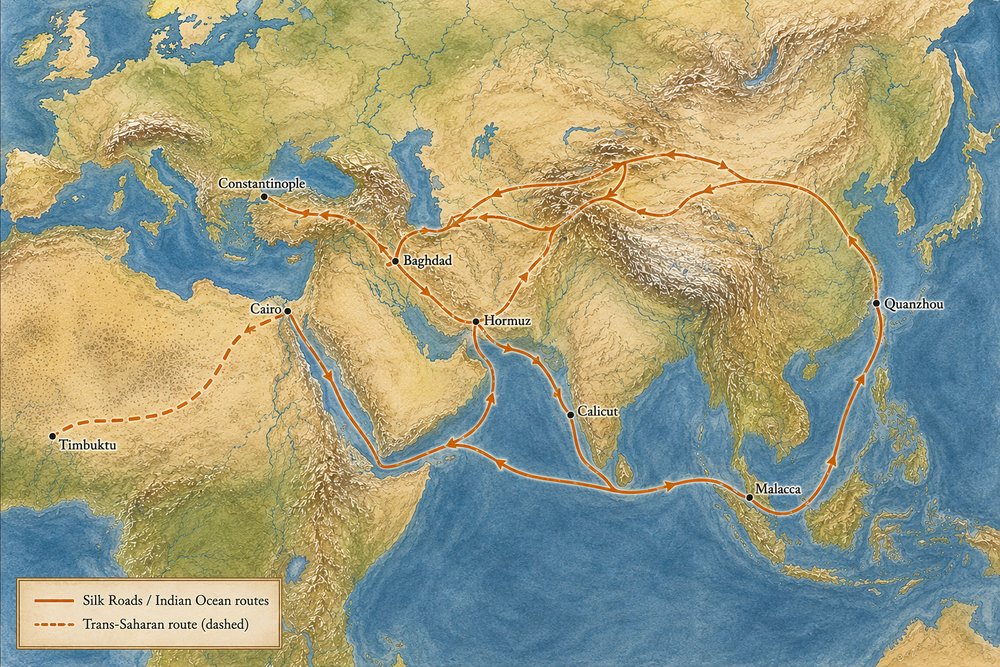
The map below shows major Afro-Eurasian trade circuits active c. 1200–1450. Based on the routes shown, which circuit connected West Africa to the Mediterranean world using an entirely overland route?
Question image
AThe Trans-Saharan route linking Timbuktu to Cairo
BThe Indian Ocean route linking Calicut to Malacca
CThe Silk Roads segment linking Constantinople to Baghdad
DThe maritime route linking Quanzhou to Hormuz
Explanation
The map marks the Timbuktu–Cairo link with a dashed line and labels it "Trans-Saharan (dashed)" — the only circuit on the map that runs entirely over land, crossing the Sahara to connect West African gold- and salt-producing regions to Mediterranean and Middle Eastern markets. The Silk Roads segment between Constantinople and Baghdad is also overland, but it does not connect West Africa. The Indian Ocean legs (Calicut–Malacca, Quanzhou–Hormuz) are maritime routes, shown as solid lines running through coastal port cities rather than across a desert interior.
Question 7 of 10
MCQU5Topic 5.1Easy No calc

John Locke's concept of natural rights held that life, liberty, and property

Aare granted by a monarch and can be revoked at the ruler's will
Bare determined entirely by religious authority, as under old church law
Capply only to members of the hereditary noble ruling class
Dexist independent of any government, whose purpose is to protect them
Explanation
Locke argued natural rights exist independent of any government, and government's entire purpose is to protect them — a direct rejection of divine-right, religiously-legitimated rule.
Question 8 of 10
MCQU8Easy No calc Image

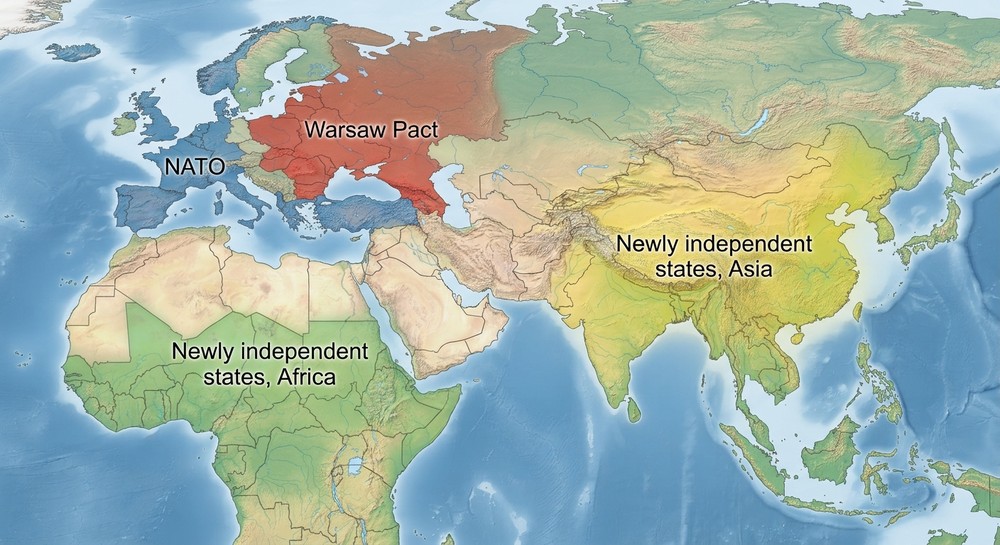
The map below shows Cold War alliance blocs alongside newly independent states in Africa and Asia, c. 1955. Based on the map, which statement accurately describes the geographic relationship between the two Cold War blocs and the two regions of decolonization shown?
Question image
AAll four labeled regions on the map physically overlap within the same area shown
BNATO's territory in Europe extends directly into the newly independent states of Asia
CThe Warsaw Pact's territory in Europe directly borders the newly independent states of Africa
DThe two Cold War blocs and the two independent-state regions all sit in separate, non-bordering areas
Explanation
The map places NATO and the Warsaw Pact as two adjacent but distinct blocks in the upper portion (representing Cold War Europe), while the newly independent states of Africa and Asia appear as two separate, non-overlapping regions below and to the side. None of the four labeled areas touch or overlap another region on the map — the point the other choices get wrong. The map shows the Cold War alliance system and decolonization as geographically distinct processes happening in different parts of the world at the same time, not as bordering or merged territories.
Question 9 of 10
MCQU9Topic 9.1Easy No calc

The shipping container's significance for global trade, per this topic, was that it

Amade cargo loading, unloading, and transfer dramatically faster and cheaper
Breplaced the need for air travel entirely on every long-distance cargo route
Cwas invented specifically to transport nuclear weapons across national borders
Deliminated the need for oceangoing ships on every major world trade route
Explanation
The shipping container — a deceptively simple standardized metal box — transformed global trade by making cargo transfer between ships, trains, and trucks dramatically faster and cheaper.
Question 10 of 10
MCQU6Medium No calc Image

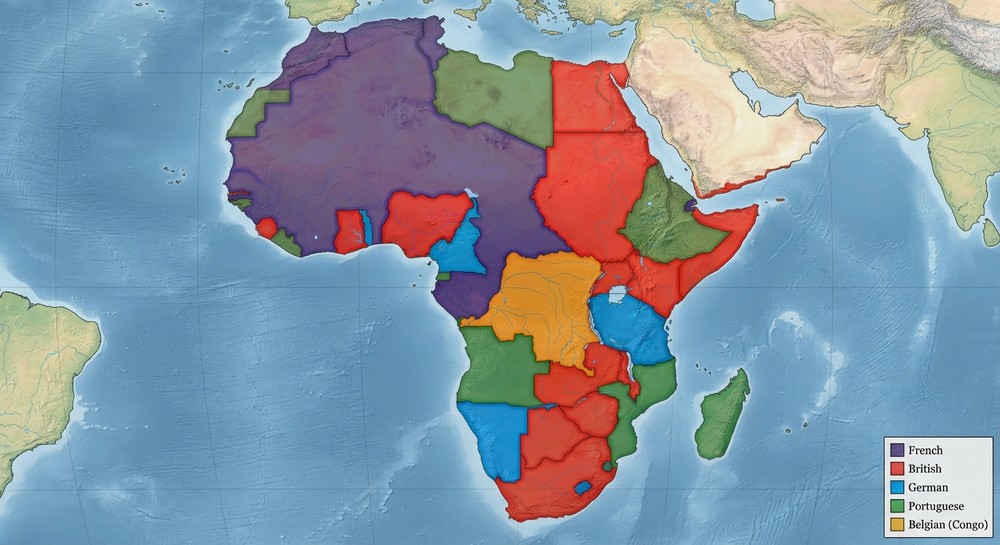
The map below shows a simplified version of European colonial claims in Africa around 1914. According to the map, which colonial power’s territory is surrounded on multiple sides by a single other power’s claim, rather than bordering several different claimants?
Question image
APortuguese territory, boxed in by Belgian claims on most sides
BFrench territory, boxed in by British claims on most sides
CBritish territory, boxed in by Portuguese claims on most sides
DBelgian Congo, boxed in by German claims on most sides
Explanation
On the map, the small orange Belgian Congo claim sits nested almost entirely inside the larger green German claim, sharing borders with it on most sides — a landlocked claim boxed in by one larger neighbor. The British (blue) and French (red) claims sit along the map’s northern and western edges, each bordering several different claimants rather than a single one, and Portuguese territory (purple) sits along the eastern edge bordering German territory, not Belgian territory as the distractor claims.
Free Response 1 · Section II
FRQShort-Answer Question (SAQ)U5 No calc

Read the excerpt, then answer parts (a), (b), and (c).

"Let their faculties have room to unfold, and their virtues to gain strength, and then determine where the whole sex must stand in the intellectual scale." — Mary Wollstonecraft, A Vindication of the Rights of Woman, 1792

(a) Identify ONE specific natural-rights argument, associated with a named Enlightenment thinker, that a document from an Atlantic revolution of this period (c. 1750–1900) borrowed directly from Enlightenment political theory.

(b) Using the excerpt above, explain how Wollstonecraft's argument exposed a specific internal inconsistency within Enlightenment political theory as it was actually applied in this period.

(c) Explain ONE specific way that the social changes brought by industrialization reorganized gender roles for EITHER working-class OR middle-class women in the nineteenth century.

Free response is self-scored — work it out, then reveal the model answer and scoring checklist to compare.

Score
Correct
Wrong
Try Again Exit