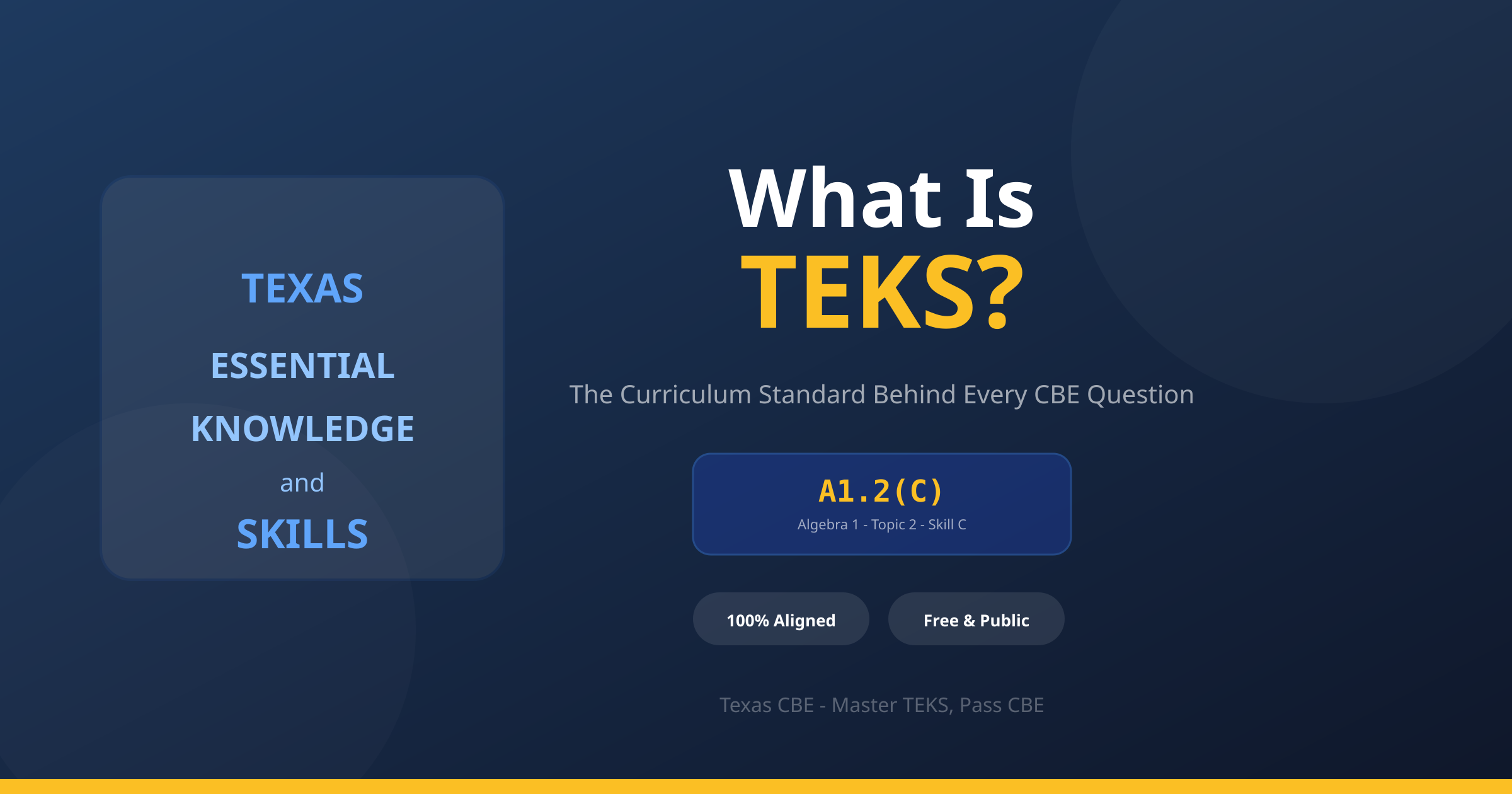
What Is TEKS? The Texas Curriculum Standard Every CBE Student Must Understand


The Three Letters That Decide Whether You Pass or Fail
If you're preparing for a Texas Credit by Examination (CBE) (CBE), you've probably seen this acronym everywhere: TEKS. Maybe you've ignored it. Maybe you've assumed it's just bureaucratic jargon. That's a mistake.
TEKS is not optional vocabulary. It's the single most important concept in CBE preparation. Here's why: every CBE exam question is built directly from TEKS. That gives you a simple, reliable rule:
So studying straight from the TEKS for your course is the most efficient prep — time spent outside it is low-priority.
What Does TEKS Stand For?
TEKS = Texas Essential Knowledge and Skills
It's the official curriculum standard set by the Texas Education Agency (TEA), the state government body that oversees public education in Texas. TEKS defines exactly what every Texas student in grades K-12 should know and be able to do in each subject — math, science, social studies, English, and beyond.
Think of TEKS as the master blueprint for Texas education. Every textbook, every test, every classroom lesson plan in a Texas public school must align with it.
Where TEKS Came From
| Year | Event |
|---|---|
| 1995 | Texas legislature mandates a new statewide curriculum standard |
| 1997 | First version of TEKS officially adopted by the State Board of Education |
| 1998-2003 | TEKS implemented across all Texas public schools |
| Ongoing | TEKS is reviewed and updated every 6-8 years (Math last revised 2012, English 2017) |
TEKS replaced the older "Essential Elements" curriculum and was designed to be more rigorous and measurable. Texas's standardized tests — STAAR, EOC exams, and CBE — are all built directly from TEKS.
How to Read a TEKS Code
TEKS codes look intimidating at first, but they follow a simple structure. Let's decode an example:
2 = Knowledge and Skill statement #2 (broad topic, e.g., "linear functions")
(C) = Specific Student Expectation C within that topic
So A1.2(C) means: "In Algebra 1, broad topic #2, specific learning goal C." This breaks education into very precise, measurable units.
Two Key Types of Statements
| Type | Example |
|---|---|
| Knowledge and Skill Statement (number) | "The student applies mathematical processes to understand quadratic functions and equations." |
| Student Expectation (letter) | "(A) determine the domain and range of a quadratic function..." |
The number is the big idea. The letter is the specific skill the student must demonstrate. CBE questions are written to test specific letter-level expectations.
TEKS by CBE Subject
Every CBE subject has its own set of TEKS. Here's how the four subjects we cover at Texas CBE™ are organized:
📐 Geometry
- 1A-1G: Mathematical processes and coordinate/transformational geometry
- 4A-4D: Lines and angles
- 5A-5D: Triangles and similarity
- 7A-7B: Right triangles and Pythagorean theorem
- 8A-8B: Right triangle trigonometry
- 9A-9B: Two-dimensional coordinate geometry
- 10A-10B: Three-dimensional figures (volume, surface area)
- 12A-12E: Circles
- 13A-13E: Probability
√ Algebra 1
- 1A-1G: Number systems and operations
- 2A-2H: Linear equations
- 3A-3G: Linear functions and slope
- 4A-4C: Inequalities
- 5A-5C: Functions
- 6A-6C: Quadratic functions
- 7A-7C: Quadratic equations
- 9A-9C: Exponential functions
- 10A-10E: Polynomials
- 12A-12E: Statistics and data
🧬 Biology
- 4A-4C: Cell structure and function
- 5A-5D: Cell division and mitosis
- 6A-6H: DNA, genetics, and heredity
- 7A-7E: Evolution and natural selection
- 8A-8C: Classification and taxonomy
- 9A-9D: Biochemistry
- 10A-10C: Body systems
- 11A-11D, 12A-12F: Ecology and ecosystems
🏛️ U.S. History
- 1A-6B: Historical events and eras
- 12A-14C: Geography
- 15A-16E: Economics
- 17A-19E: Government
- 20A-22E: Citizenship
- 23A-25D: Culture
- 26A-28B: Science, Technology, and Society
- 29A-32B: Social Study Skills
Credit by Examination asks for 80% with no prior instruction. Full-length mock exams written to the same TEKS the exam is drawn from — Algebra 1, Geometry, Biology, Chemistry and more.
See the subjects →
Every subject has free practice questions with the full worked solution. Take some and see whether they look like the exam your district set.
See the subjects →
Every Credit by Examination window we have verified from a district's own calendar — 22 districts, 75 windows, each with the source it came from.
See the deadlines →
Not a guess at what might be on it. Full worked solutions and timed mock exams built to the same TEKS the Credit by Examination is written against.
Browse the subjects →The Critical Language Distinction: "Including" vs "Such As"
This is one of the most overlooked aspects of TEKS, and it directly affects how you should study.
"Including" — REQUIRED
When a TEKS statement says "including", the listed items MUST be mastered. They will appear on the test.
→ Hardness, color, luster, streak: required
"Such As" — EXAMPLES
When a TEKS statement says "such as", the listed items are examples only. Other examples may be used on the test.
→ Other properties may also appear
If you ignore this distinction, you might over-prepare on irrelevant material or under-prepare on required content.
Why TEKS Matters for CBE Students
1. The Test Is Built From TEKS
CBE exams are not random. Every question maps to a specific TEKS standard. UTHS publishes test blueprints showing the percentage of questions from each TEKS domain. If you know the blueprint, you know what to focus on.
2. Studying TEKS Tells You What NOT to Study
Most students fail CBE because they study too much of the wrong things. Textbooks cover topics far beyond TEKS. Online resources include irrelevant material. Studying TEKS lets you eliminate everything that won't be tested.
3. TEKS Maps to Real Skills
TEKS isn't just rote memorization. It's organized around skills students should be able to demonstrate — solve, analyze, compare, evaluate. CBE questions test these skills directly.
4. Free and Public
The TEKS document is freely available on the Texas Education Agency website. You don't need to pay for any "secret study guide" — the official curriculum is public.
How to Use TEKS to Pass Your CBE
Step 1: Get the TEKS Document
Visit tea.texas.gov/curriculum/teks/ and download the TEKS for your subject.
Step 2: Make a Checklist
For each numbered statement, write the corresponding (A), (B), (C)... letters as a checklist. Every item is something you must master.
Step 3: Self-Assess
Go through each TEKS expectation and rate yourself: 🟢 Mastered, 🟡 Need review, 🔴 Don't understand. This is your study roadmap.
Step 4: Practice TEKS-Aligned Questions
This is where Texas CBE™ comes in. Every one of our 1,760+ practice questions is mapped to a specific TEKS code. When you miss a question, you'll know exactly which TEKS to study.
The Bottom Line
TEKS isn't optional. It isn't bureaucratic noise. It's the literal source code of every CBE exam question. The students who pass CBE are the ones who treat TEKS as their primary study guide. The students who fail are the ones who ignore TEKS and try to "study everything."
The good news? TEKS is free, public, and finite. With focused practice on TEKS-aligned questions, passing CBE becomes a matter of methodical preparation, not luck.
Sources: Texas Education Agency (tea.texas.gov), UTHS CBE Documentation, 19 TAC §74.24. Texas CBE™ is not affiliated with TEA or UTHS. All practice questions on Texas CBE™ are original content mapped to public TEKS standards.
Frequently Asked Questions
What does TEKS stand for?
Who creates the TEKS?
Are STAAR and CBE both TEKS-aligned?
Where can I find the TEKS for a specific subject?
Do private schools and charter schools follow TEKS?
- Texas Education Agency (TEA) — State agency — TEKS, STAAR, and graduation rules
- Texas Administrative Code, Title 19 (Education)


